|
We
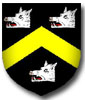
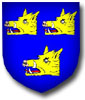
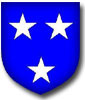
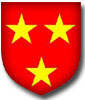
frequently see three charges, two and one, as the many boars'
heads, Nisbet, Swinton, Gordon, all from Berwickshire, or the
stars of Moray. When combined with a chevron, these retain their
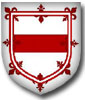
position, but when a straight ordinary, bend, chief, fesse, is
introduced the three charges are usually placed on the ordinary,
as in Pringle, Mure, Douglas. Thus we see the (probably) ancient
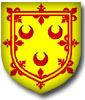
arms of Scott still carried by the Scotts of Harden, now Lords
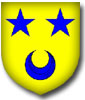
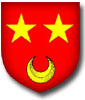
Polwarth as Or, two stars and a crescent Azure (compare ancient
Kirkcaldy Gules, two stars and a crescent Or), while the chiefly
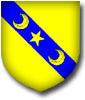
line of Buccleuch carries Or on a bend Azure a star between two
crescents of the first. |
|
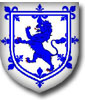
The
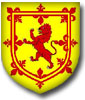
other particular charge born in Scotland, by the most highly
honoured and by their descendants, is the tressure flory counter
flory, otherwise known as the Royal Tressure. It is known that the
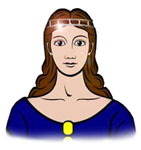
daughters of the House of Charlemagne were accustomed to wear a
‘tresson’ which framed their hair. |
|
It is
a curiosity that the tressure seems only to be common in the arms
of Flanders and of Scotland. In fact the tressure probably derived
from the influx of Flemish blood into Scotland in the early
twelfth century. The tressure was adopted by the King, probably
denoting his descent from Charlemagne, and was granted by the
monarch as an honourable augmentation, although doubtless not thus
known at that time. The recipients were those who had served
especially well, or who had intermarried with the royal family.
It may also be borne by families which have roots in Flanders,
perhaps because the blood of Charlemagne also coursed through
their veins. |